By Susie Piegza
When I think about why I care so much about travel, it’s not just the landscapes or the food (though those are wonderful). It’s the people. The women running a small guesthouse at the edge of a village. The weavers who bring out their work, spread it on a table, and tell you about the patterns their mothers and grandmothers taught them. The kids in school uniforms who wave as you pass by.
Over the years, I’ve watched how a certain kind of travel actually helps those people thrive—not just “not harming,” but quietly strengthening communities. These days, a lot of people call that regenerative travel: travel that leaves places better off, especially in terms of culture, livelihoods, and opportunities for the next generation.
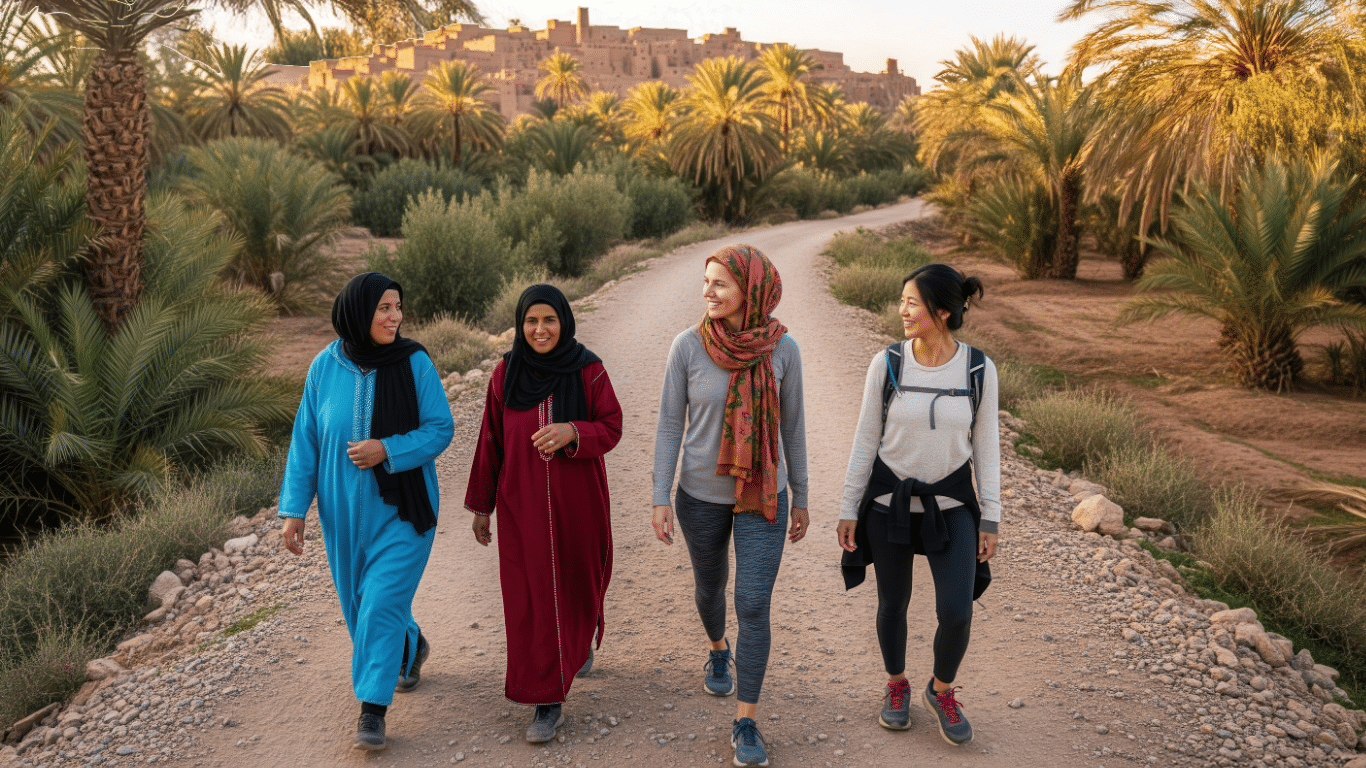
As a woman, and as someone who explores mostly on foot, I’ve also come to see that when women travel—especially in small groups and at walking pace—the ripple effects can be surprisingly powerful.
Let me tell you a bit about what I’ve seen, and what the research backs up.
Women’s work is everywhere in tourism
Walk into almost any hotel, café, or market in the world and start paying attention to who is doing what. You’ll notice something: travel and tourism run on women’s work.
Global numbers bear that out. International organizations that study tourism and gender have found that women make up more than half of the global tourism workforce—around 54%, which is a higher share than in many other sectors. In big economies, travel and tourism employ a greater proportion of women than the economy overall, and women are better represented in management and entrepreneurship than they are in some other industries.
When you’re on a small walking trip, you’re close enough to see that clearly. The woman who owns the tiny hotel you’re staying in. The female guide who walks you through a market. The women cooking dinner in a family‑run restaurant. They’re not anonymous; they introduce themselves, they tell you about their families, they ask where you’re from.
Every time we choose those places—book that inn, eat at that restaurant, hire that local guide—some of our travel budget goes straight into women’s hands.
Craft cooperatives turn travel spending into schoolbooks and clinics
There’s a special place in my heart for women’s cooperatives. I’ve met them in so many different forms: weaving groups in one country, embroidery in another, cooking collectives somewhere else. The pattern is often the same. The women start with a skill they already have—something they’ve been doing at home for years—and then they organize together, learn to price their work, and find ways to sell directly to visitors.
I remember one morning in a village where the women had set up a small cooperative to sell their textiles. One of them explained, very matter‑of‑factly, that before the co‑op, most of the money in the household came from seasonal work the men did. Now, with their own income, they’d been able to keep their daughters in school longer, pay for uniforms, and even set aside a little for emergencies.
They’re not alone. Case studies from different parts of the world tell similar stories: when women earn through cooperatives, they tend to use that money on school fees, uniforms, books, healthier food, and medical care for their children. In some places, co‑op income has funded day‑care centers so women can work while their children get early education and nutrition. In others, it has helped run community clinics and support scholarship funds, especially for girls.
From the outside, it looks like “buying a beautiful piece of handwork.” From the inside, it might be new notebooks for a classroom or an extra year of school for a daughter.
Tourism can give women more say in their communities
Another thing I’ve noticed—slowly, over time—is that when women earn more from travelers, they often gain more voice.
One example that stuck with me came from a project centered around a long‑distance walking route in a rural area. Training programs prepared local residents to host visitors: opening guest rooms, cooking meals, guiding walks. A majority of the new jobs ended up going to women. When researchers went back later and talked to those women, they described something more than just extra income. They talked about feeling more confident speaking up in village meetings, taking on roles in local committees, and being part of solving problems in their communities.
Other studies echo that pattern: when women participate in tourism ventures and get training and support, they often move from “helping” to actually leading—running guesthouses, chairing cooperatives, starting small businesses. They become the people who decide when a path needs repairing or a school needs paint, not just the ones who carry out the work.
On a walking trip, you sometimes get to sit at their kitchen tables or on their terraces, drink tea, and hear how all of that unfolded. It’s one of my favorite parts of travel.
Walking “at eye level” keeps money local
One of the big differences I’ve seen between walking trips and more conventional touring is how money flows.
When you’re on a bus that stops mostly at big, highway‑adjacent restaurants and large hotels, a lot of your spending goes to big companies and intermediaries. When you’re on foot—staying in small inns, stopping for lunch in village cafés, popping into tiny shops that sell local goods—you’re constantly interacting with people whose livelihoods are rooted in that specific place.
Economists sometimes talk about “leakage,” when money leaves a destination instead of circulating locally. Walking makes it easier to do the opposite: to spend where the owner is also your host or neighbor, and where the profits are more likely to be reinvested in the community, whether that’s fixing a roof, paying staff, or giving their own kids a chance at higher education.
I’ve watched this play out in very simple ways: the woman who tells you that the extra income from guests let her family repair their home; the restaurant that expanded its kitchen with earnings from travelers; the guide who put her younger siblings through school on her guiding income.
Those might seem like small things, but added up across a region, they matter.
Women travelers often seek connection—and that changes the kind of impact we have
There’s one more piece that feels important: what women travelers themselves are looking for.
Over and over, I hear the same themes from women, especially in their 50s, 60s and 70s. They want connection. They want to understand how people live. They want to feel that their time and money are supporting something real and positive, not just skimming across the surface of a place.
You can see that in the questions women ask: “How long does it take your children to get to school?” “Do most girls stay through secondary?” “Did your mother teach you this craft?” “What do you hope your daughter will get to do that you didn’t?”
Those questions aren’t just polite conversation. They signal that women travelers are paying attention to education, to opportunities, to the future. And when you care about those things, you tend to choose trips and experiences that support them—staying where your money matters, visiting cooperatives that reinvest in kids and communities, and walking with guides whose work helps them build a different life for their families.
I’ve come to see walking travel as a kind of quiet partnership. On one side, women who have spent years building skills, families, and communities; on the other, women who are at a point in life where they’re ready to see more of the world and do it thoughtfully.
We get unforgettable days—wandering through markets, crossing village squares, following paths with views we’ll remember forever. They get something too: income, recognition, a stronger voice, and better chances for their children.
When it’s done with care, travel on foot can be regenerative in the simplest, most human sense: one woman’s journey supporting another woman’s future.
Susie Piegza is COO and Founder of Classic Journeys. She worked in Economic Development prior to founding Classic Journeys and remains active in philanthropic ventures that help to support women and children.