Puglia may be Italy’s breadbasket, but on foot it felt to me like an open-air dining room, with the countryside as its ceiling and a different pasta shape waiting at every table. Over six days and five nights with Classic Journeys—from Lecce’s Baroque streets to Matera’s cave dwellings, from the Ionian reserves to the trulli belt and ancient olive groves—I came to understand why this region is spoken of in near-mythic terms by pasta lovers and food writers alike.
Walking Into Puglia’s Story
I met my fellow travelers—a baker’s dozen of us in all—in Lecce, where honey-colored stone palaces and exuberant churches glowed in the late-afternoon light. Our hosts were Ulisse, a second-generation Classic Journeys tour leader, and Katerina, another expert local guide; between them, they seemed to know every piazza, pastry counter, and grandmother with a pasta board within a hundred miles. That first evening, as we strolled past the Roman amphitheater and watched locals spill into the squares for aperitivi, I had a sense that this trip would be less about ticking off sights and more about slipping, however briefly, into Puglia’s daily rhythm.
The next morning we drove east toward Otranto, leaving Lecce’s polished façades behind for a rougher Adriatic coastline of cliffs, scrub, and dazzling sea. Our coastal walk traced Italy’s easternmost point, past WWII bunkers and craggy watchtowers, with the Torre del Serpe lighthouse keeping silent watch above us. As we walked, Ulisse told the story of the 1480 Ottoman invasion that once put this secluded corner of Puglia at the center of the Mediterranean map, and suddenly the ruins and towers around us felt less picturesque and more like footnotes in a living history.
A Masseria Lunch That Set the Tone
By midday, our path delivered us to a restored masseria perched above the sea, a fortified farmhouse turned gracious refuge where we lingered over what was billed as a “light lunch” but felt more like a culinary overture. Between courses—local cheeses, vegetables shimmering in olive oil, a first taste of handmade pasta—the conversation bounced between our group’s home cities and Ulisse’s explanation of why durum wheat from this region is prized above all others in Italy. Puglia is the country’s leading producer of this hard wheat, and hearing that while looking out over fields and sea gave those statistics the weight of lived truth.
Back in Lecce that afternoon, Katerina led us through alleys where stone carvers once plied their trade, pausing at her favorite gelato shop and flagging the best spots for a spritz or dinner later. It was the sort of orientation walk that quietly sets you up to feel at home in a city, and as I ate orecchiette with cime di rapa that night at a tiny trattoria she recommended, I realized I was already beginning to connect dishes on my plate with stories I’d heard on the trail.
Wild Coasts, Quiet Towns & The Wheat Behind the Pasta
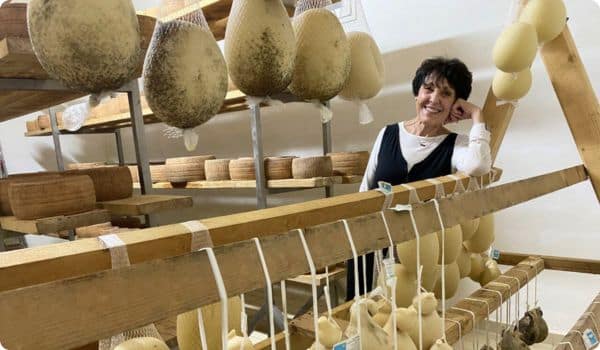
The following day, we swung to the Ionian side at Porto Selvaggio Nature Reserve, trading Baroque façades for pines, Mediterranean scrub, and cliffs riddled with Paleolithic caves. The trail dipped toward hidden coves and climbed past medieval lookout towers, with seabirds riding the thermals above us, and at one point Ulisse stopped to point out Grotta del Cavallo, a cave that has yielded evidence of some of Europe’s earliest modern humans. There was no pasta in sight there, only sea and stone, but the sense of deep time hung in the air, the same way it would later among Matera’s caves.
We lunched in Nardò, in a café-lined piazza where office workers and families filled outdoor tables, then turned inland toward Matera as the landscape shifted from coastal plains to increasingly stony hills. That evening, over a dinner that married Matera’s creative cuisine with regional wines, Katerina leaned across the table and said, almost offhandedly, that much of the pasta consumed across Italy can trace its grain back to fields not far from where we’d be walking the next day. It was the kind of remark that lodges in a reporter’s notebook—and in a traveler’s imagination.
Matera’s Canyons & Altamura’s Bread
Morning in Matera began not in a museum but on a trail. We descended into the Gravina canyon along a path that Classic Journeys has curated, passing rock-cut chapels and abandoned dwellings that seemed to grow straight out of the limestone. When we climbed back to the Sassi, weaving through staircases, terraces, and lanes where cave houses had been restored as modest museums, the domestic details—bread ovens, simple tools, narrow beds—made the place feel less like a backdrop and more like a living, if austere, neighborhood that had only recently stepped into the modern era.
That afternoon, we drove into the countryside around Altamura, where the wheat fields finally took center stage. We passed homes with tomato vines drying in the sun and communal ovens where locals still bake Pane di Altamura, the only bread in Italy with DOP status and a product praised by the Roman poet Horace as the best in the world. On Maria’s family farm, hundreds of sheep grazed on nearby hills while pigs rooted in shaded pens; inside, the kitchen was warm with the scent of baking bread and simmering sauce.
Maria poured homemade wine and handed us knives and dough. Under her eye and Ulisse’s translation, we rolled ropes of semolina-based dough and sliced and dragged them into orecchiette, the signature “little ears” of Puglia. Around me, other travelers fell into the same rhythm, some in deep concentration, others laughing at misshapen attempts. Dinner unfolded in that same kitchen: free-range lamb from the farm’s flock, peppers stuffed in the local style, the orecchiette we had shaped now cloaked in sauce, and a ricotta cheesecake so light and tangy it quietly reset my expectations of what dessert could be.
From Stone City to Olive Country
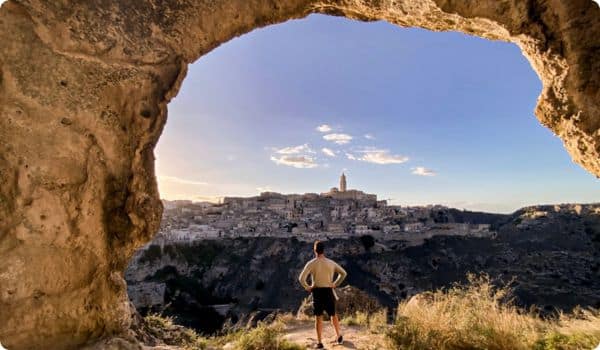
Leaving Matera the next day, we traced paths across the plateau of Parco delle Murgia, looking back as the stone city gradually receded across the canyon. Empty cave dwellings lined the opposite cliffs, and as we walked Ulisse spoke about families who had only moved out of these grotto homes in the mid 20th century—a reminder that “ancient” in southern Italy can mean yesterday as much as millennia ago.
By midday, the landscape softened into the undulating Val d’Itria, its patchwork of vineyards, red soil, dry-stone walls, and the occasional trullo punctuating the horizon like a child’s drawing. At a masseria near Ostuni and Cisternino, siblings Filippo and Chiara hosted us for lunch in a courtyard shaded by olive trees, bringing out plates that seemed almost too simple for the flavors they delivered: vegetables from their own gardens, pasta made on site, and olive oil that tasted of grass, sunlight, and something vaguely peppery at the finish. As a travel writer, I’ve seen “farm-to-table” used to the point of meaninglessness; here, it felt redundant to even say the words.
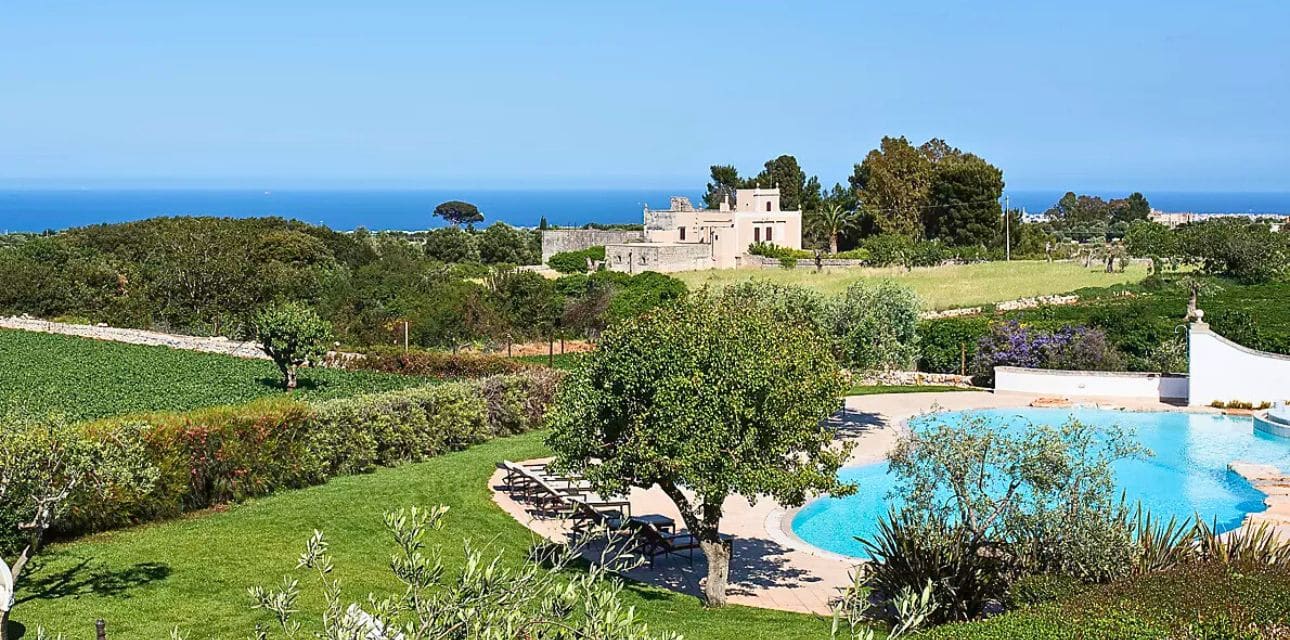
Later, we walked among the olive trees and low stone walls at Lama d’Antico, passing traces of prehistoric cave dwellings nearly swallowed by vegetation. By the time we reached our coastal masseria in Savelletri that evening, with its pool, spa, and views toward the Adriatic, the line between landscape, history, and what appeared on my plate had blurred into a single, coherent story.
Trulli, Tax Laws & Olive Trees Older Than Nations
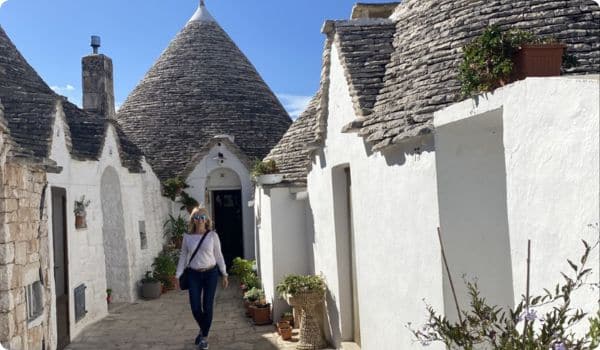
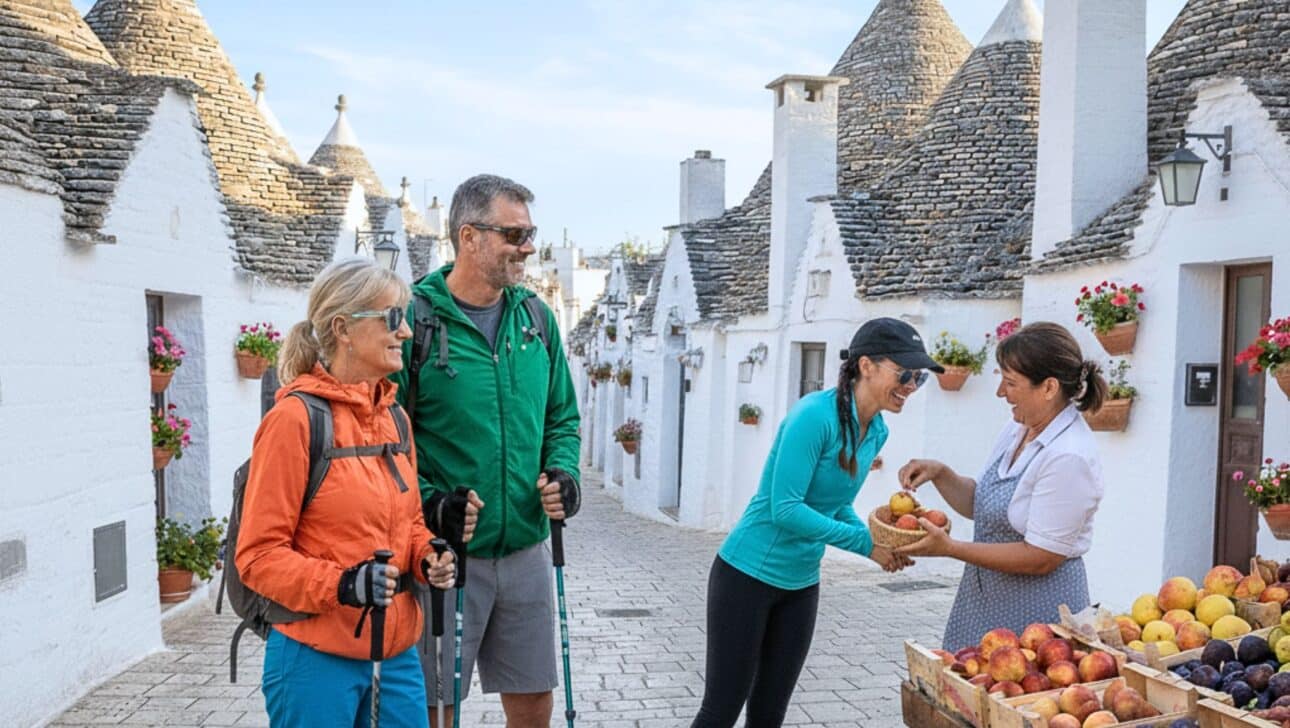
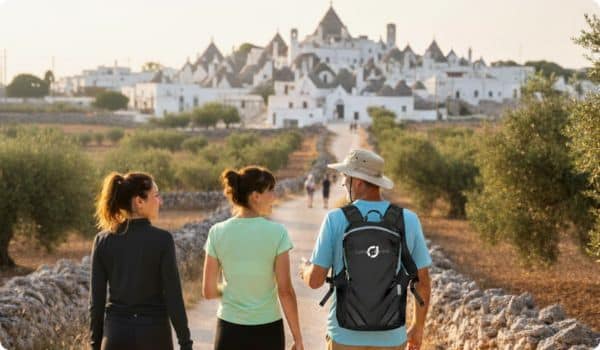
If Puglia has a fairy-tale chapter, it is Alberobello. We approached on foot, following a path through oak woods and vineyards until the first conical roofs of trulli appeared above the fields. Wandering into town with Katerina, we learned how locals, facing 15thcentury tax rules from the Kingdom of Naples that levied tributes on permanent new structures, responded by building houses of dry stone, without mortar, so they could be dismantled quickly when royal inspectors arrived. It was an ingenious bit of bureaucratic judo that happened to leave behind one of Europe’s most distinctive skylines.
Inside some of those trulli now are cafés and shops; others remain homes. I ducked into one for a quick espresso, then rejoined the group to explore narrow streets and peek at symbols painted in white on the roofs—crosses, hearts, mysterious signs whose meanings seem to shift with the teller. Lunch that day included yet another riff on pasta and vegetables, and I realized I’d stopped ordering it as a “pasta dish” and started thinking of it as a daily conversation with the local wheat and produce.
That afternoon, we walked out of town through some of the most ancient olive groves I’ve ever seen, trunks twisted and gnarled into sculptures that predated most modern nations. At a family-run olive-oil estate, a member of the family led us through a tasting that felt like a wine seminar: discussion of varieties, harvest timing, milling methods, then sips from small cups, each oil revealing its own personality—mild and grassy, robust and peppery. I scribbled the names in my notebook, already suspecting that back home, any bottle labeled “extra-virgin olive oil” would now seem unforgivably vague.
A Leisurely Goodbye, A Lasting Aftertaste
Our last morning in Savelletri unfolded at a gentler tempo. Some of us walked among the olive trees, others claimed loungers by the pool; I lingered over breakfast, making mental notes for this story while the week’s images played in my mind. When our transfer finally pulled away toward Brindisi, I realized how different this experience had been from a typical “food tour.” We had certainly eaten well—spectacularly well—but the meals had always been anchored in place: in a canyon city of caves, in the wheat fields of Altamura, under the arches of masserias, among trulli and ancient trees.
As a travel writer, it’s tempting to declare any particularly good region “a paradise” for something. In Puglia’s case, the cliché happens to be true: it is a paradise for pasta lovers, yes, but only because it is first a paradise for wheat, for bread, for olive oil, and for the everyday ingenuity of the people who turn those things into sustenance. Walking with Ulisse, Katerina, and a small group of fellow travelers, I learned that you cannot separate the orecchiette on your plate from the thumb that shaped it, the field that grew it, the cave or farmhouse where it is eaten, or the stories told over the table.
That is Puglia’s real gift: not a single perfect dish, but the understanding that in this corner of Italy, pasta is simply the most delicious expression of an entire way of life—one best absorbed, and digested, at walking pace.
Explore Puglia
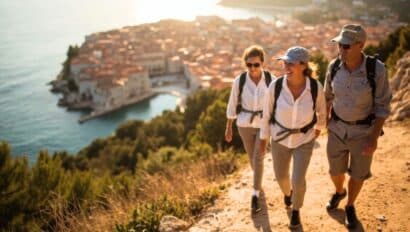
A Dalmatian Dream: Walking Through Centuries, Islands, and the Unexpected in Croatia
By Julie Gennaro